Saturday, January 11, 2020

The Lay of the Land


Wow. Touring the community just makes us love it even more.  We got up between 6:45 and 7:15 (depending on whether we were on the breakfast crew) and walked the length of the area (maybe two miles? maybe less?) to visit the fish farm where 12 or so fish cages are anchored on sticks in the water and stocked with between 400 and 1000 fish (depending on size).  We went out to the cages in a couple of low boats and sidled right up to the cages where our host Dona Odila (pronounced oh-GEE-luh) threw in some hard food pellets and the fish went into a frenzy to get to them. 

We learned a little bit more about how they started the fish farm and how Saint Mary’s participated in growing it in past years.  We made plans to return to feed the fish later, with the possibility that some of us will actually go into the cages with the fish and get up close and personal with them.  

We took the long way around to get to another related project from past years: the fish food factory.  The locals learned how to make high protein food from the elements all around them to save the money, time, and hassle involved in buying food from far away São Paolo.  The 2015 SMC group cleared and area and laid the foundation and first few feet of bricks in the walls of the large structure we visited today.  There was no production today but there will be during the time that we are here and, of course, we will participate.  

From there, we stopped by the community water tank and learned about the vast difference this grant-funded project made in the health and wellbeing of the community.  It involves a deep groundwater well, a microfiltration system, a huge pump that gets run twice a day, and a gravity-driven system of pipes that deliver water throughout the community.  

As we left the water tank, we took a quick look at the soccer field where we are likely to play at least two games against local men and two games against local women.  If past history is any indication, we are not in danger of winning many of these games. (But let it be known that our women are the current defending champions.  Unfortunately, the last game our women won in 2017 is the one and only game any of our teams have ever won against our Brazilian opponents.)

We then visited the community garden and chicken coop that were built over a series of SMC trips between 2014 and 2017.  The main keeper of the garden, Vicente, has had some health problems that involved a surgery in December and both the garden and the coop have fallen into a bit of a state of disrepair.  But because we know what it takes to clear and turn around a patch of ground here because of prior DIRT projects, we can see that it won’t take a huge amount of work to revive both of these projects.  It is important to find other community members to help support Vicente and his wife Madalena, so we might need to hold some comprehensive community meetings to see who wants to step up.  

We returned home for lunch (piraricú fish, pork, beans, rice, pasta, and salads, with acerola and maracuja juices to drink) knowing that our next appointment was nearly three hours away.  We capitalized on the time and did some organizing of our camp (with more to come) and some of us caught up on laundry.  The most shrewd of us did some organizing, took a quick swim in the river, and also caught a quick nap.  Turns out that not that many of us qualify as “shrewd.”  

Jaron in particular was one who made sure that a swim was on the agenda, but he expressed our ongoing inability to grasp the vastness of the rivers here when – after finishing another job --  he said: “I just want to go into the ocean.”  We don’t have an ocean but he and many others found their way to the river after lunch for a dip.  

We had arranged to visit the beekeeping operation of the family of one of our friends here named Aldair. We went back behind his family’s home and checked out the unusual (to us) hives of the unusual (to us) stingless bees that are native to the area.  Aldair’s family lured some swarms of bees out of the forest and into their vast property and now they – like several other local families – harvest the honey and, to a much smaller extent, the pollen, wax, and royal jelly.  We tasted the honey and loved it.  It’s thinner and less sweet than honey we are used to in California groceries and it turns out they use it a lot differently than we do, as they focus primarily on its medicinal properties.  

Some of us headed away from the bee zone to rejoin Odila at the fish farm so that we can swim in the cages with the fish.  Others hit the river, while others did laundry or got more things organized.  Everyone is working on videos and photos daily as well and they will come to you somehow through these pages when we can make it to a place where we can upload them.  

Thanks for your patience as we settle in here in our beautiful sanctuary from our normal lives.  We are thinking of you and have lots more to tell you than what you are reading here.  Please keep checking back and post comments if you have something to tell us or ask us!


Dona Maria Odila gives a tour of the fish farm from the boats.


Families from the Anã’s community grow fish in cages along the shallows of the Arapiuns Lake.


Rylee and Boo very excited about learning about the sustainable fish farm! 


Aldair  (ow-dai-ee) shows the DIRTies Anã’s bee program. These bees are stingless and came from the forest. It took many years for the locals to learn the best way to keep them and make use of their honey. Families are able to participate by taking care of their own hives. The honey produced in the hives can be sold to tourists or people in the community and can be used as food or for medicinal purposes. 


Aldair extracts fresh honey from one of the hives. He let us all taste it and it WAS AMAZING! It was so sweet and pure, and nothing like U.S. honey. 


A sign on the front of a community store in Anã.


A photo of Dona Odila in front of some beautiful amazon scenery from our morning tour of the community. 


Lauren Smith living her best life with her new friend the local monkey Nico. 


A photo of a telephone booth known as “the big ear” to the locals.


Aldair, a member of the community, explaining how the honey in Anã is produced. 

Embark and Arrive


An early morning didn’t seem so bad because we were so excited to make our next move. We were remarkably efficient about gathering our gear, which is even more impressive than it sounds because we have a LOT of gear.  We are traveling with our own personal belongings, of course, but we also have bags of tools (including cordless power tools), tons of first aid and “medical” supplies, lots of extra food (like Clif bars, hot sauce, and Ritz crackers), and an incredible array of goods that we believe will make our camplife more efficient (like clotheslines/clothespins, backup flashlights and headlamps, and various things to help us ward off mosquito bites).  So when we move around, we literally have about an actual ton of stuff (probably a little bit more) to wrangle.  

But that ton of gear was no match for us this morning, as we had it fully under control and ready to load long before our actual planned departure time. We even managed to make it all happen in one vanload, which seemed like it would be impossible.  We hustled down to the riverfront to connect to the community boat and found it in a tangle of other similar boats, all painted blue and white, all with similar designs, but distinguishable by their unique names.  Ours was called “Josué Yeshuah” and the crew knew that we were about to show up with crazy piles of baggage. The water is pretty high right now so we could walk right up to the boat and load bags in from the shore.  In past years, we either had to walk through long muddy shallows to get to the boat or actually ferry things out on smaller rowboats.  So this load-in was cushy.  

The boat was pretty full, mostly because of our bags.  They were all through the underdeck and stacked along the middle of the main deck the length of the boat.  Some of us used them for seating, some of us used them to sleep.  

We got out into the open water and were immediately awed by how vast the rivers of the Amazon are.  We were technically mostly on the Tapajós, which meets the river that is actually called the Amazon right at Santarém.  As you might notice in our pictures (assuming we’ve managed to post them somewhere along the line), there is a big line offshore where the brown river (the Amazon) and the blue river (the Tapajós) run alongside each other in different colors but don’t merge.  Our destination was technically the Arapiuns river, which is said to be the cleanest and most beautiful of the Brazilian Amazon tributaries. 

On the boat, we were amazed by how warm and welcoming all of the locals were, especially a precocious 4-year-old named Nicola, who gave a few of us some of the best direct Portuguese language instruction we’ve had so far.  We snacked on local chips and cookies, including hamburger-, chicken-, and ham-flavored chips and cookies that tasted like cupcakes.  Some of us sat out on the prow for a bit and took in the vastness of the waterway we were navigating.  A lot of us journaled and a few of us slept.  Our four hour trip felt like no big deal.  

As our boat approached the shore near Anã, we could see different folks start to collect on the bank, awaiting our arrival.  A bunch of them were little kids.  So as soon as we got close enough, the bags started moving onto the beach and eventually up a staircase where they were met by an “ox cart” (but no ox – except the locals and/or us) and delivered to our camp.  Our group set up a series of bucket lines to move our pile a little ways down the beach, then a little bit more, then up the stairs, then onto the cart.  Some of the locals joined our line, while some of them just picked something up and carried it all the way from the boat to the guesthouse.  Even the little kids were fearless in grabbing our fifty-pound bags and running down the beach in the deep sand to deliver them where they belonged.  

Once we got to the top of the stairs, we were thrilled to be on a rainforest path to head into our new home. The first building we encountered was our ôca (or hammock hut), which is a big round building with a huge pole (an actual tree trunk) in the middle that has hooks all around it.  Around the outside of the screened hut are more hooks, which in combination with the center ones become the supports for our hammocks.  Also along the outside walls are cabinets for the hammock spots that mean each of us has a little wedge of the room as “ours,” with a few extra cabinets and spaces to set up our various gear zones: tech, tools, sports, meds, camp.  We don’t have it all arranged properly but we’ve gotten pretty far pretty fast.  

The next building is the bathhouse, with four indoor showers and two outdoor ones, plus four individual toilet stalls and a laundry area.  Just down the path from that is the kitchen and dining area that we call the pousada.  It seems clear that we will live a lot of our collective life in the pousada.  

That’s where we gathered with our local hosts and met each of them individually. We each introduced ourselves as well.  We ate a quick snack of some local foods made of the regional dietary staple mandioca (which would be called manioc in the US). And because we were hot and sweaty from our load-up, boat ride, and load-in, we made our first foray into the beautiful Arapiuns to throw a frisbee, relax, and cool off.  The sand is soft, the water is warm, and the sky is beautiful on the beach nearest us, and we heard ourselves saying words like “perfect” and “paradise” more than we might have predicted for our first day onsite.  

We had a dinner of tambaquí (from the community fish farm), chicken, beans, rice, pasta, salad, and a cupuaçú dessert.  We drank maracujá (passionfruit) juice and lots of water to help us overcome our day in the sun.  

We gathered for our nightly reflection and love for this place flowed freely.  We shared the desire to tell everyone who had expressed anxiety about our January destination that we truly think we feel safer and more at peace here than we ever have anywhere else in the world.  Different ones of us talked about our friends’ and families’ expressed fears and we just couldn’t get over how far off base all of them were. 

As we climbed into our hammocks, rain started to fall, bringing welcome white noise to help us find a state of slumber. We have some snorers but no one snored enough the whole night through to stop us from sleeping quite well.  We know that it will get even easier to sleep when we start to do our work, as we are going to hit our hammocks on those days even more tired than we did today. 

Saturday will bring a tour of the community and our first look at the jobs that prior groups have already done.  We are definitely getting the impression that those groups had big impact and are remembered fondly.  Seems like we are primed to carry on this proud tradition.  


On our long boat trip from Santarém to Anã, our double-jointed teammate Jaron fell asleep… for Boo, mimicking him was too hard to resist. 


We finally arrived to Anã after two painful days of travel and a 4-hour boat ride. This is the beach we pulled up to, at which we swam after we DIED moving bags.  


This is the Ôca, our home for the next two weeks. Also included is the washer our program bought for the community! 


This was also on the boat ride, after Boo mimicked Jaron (as you can see, he’s still asleep).  Boo and this little girl, Nicole (pronounced nic-o-lee), became the best of friends. Even better, she taught Boo a lot of Portuguese!


The Josué Yeshuah, the vessel that transported us from Santarém to Anã.  

[Special Note: the team below used screenshots to try to save bandwidth.  We think we have figured out another way so we won't likely do it like this later.  A few more days will be like this because we are behind.]


Jaron and our new friend Nicole (pronounced Nikola) playing a game of patty cake. There was an obvious miscommunication here!


View from the boat heading down the Amazon river to Aná.


The hammocks hanging in the boat were so close you could roll off one and land on another.


The view from our ôca which shows the orange bath house to the right and clothes hanging on a clothesline to the left.


Saying “Tchau!” to our bus driver, Maia, at the docks!  

Thursday, January 9, 2020

Machetes and Pink Dolphins


[Special note: We managed to get some videos to load. Go back and check prior entries to see some shots of our lives in the Amazon.]

Today we slept in probably longer than we will on any other day for the rest of the month.  We had a pretty quiet night even though the dogs started up their little routine again in the night.  But little did they know that one of our most important purchases yesterday was a pump action squirt gun that allows us to step outside the door, pump the squirter, and send the barking dogs scurrying away somewhere where they are either quiet or we just can’t hear them anymore. We got a handle on the temperature thing too for the most part, but our perfected system will only work for one more day as we are heading out to Anã tomorrow morning.  

Speaking of Anã, today we had a visitor from there:  our friend Ingrid, whose parents – Tonico and Reginalva -- were some of our first contacts and friends in the community.  Ingrid has now joined them as part of the leadership of the community association and has served as our primary liaison in making arrangements for this trip.  

The fact that the community itself is managing our relationship with it is big news, as we have always worked through an intermediary non-governmental organization (NGO) called Saúde e Alegrîa (Health and Happiness) to make contact and arrange for our prior visits.  Our first visit to this community was in January of 2014 and then a year after our visit, the community formed an ecotourism/arts collaborative called Turiarte, which now takes responsibility for the relationships between visitors and the community. 

In fact, Anã has become a model of community self-governance in the region and its leadership is often featured in news and political stories about the promise of the area.  And other communities either visit Anã to see what they can learn or invite the folks from Anã to visit their communities to advise them on how to make progress on quality of life issues of importance to them.  

When we first visited this community, we learned that they had been concerned about their high infant mortality rate, their lack of adequate sources of protein, general nutritional issues, and their systems for water and sanitation.  We heard about the community organizing that they did to identify the problems they perceived and strategize about how to address them.  They developed staged planning models (five year, ten year, etc.) about where they hoped to get as a community and what ideas would help them to get there.  

They had already secured a government grant for a water system when we arrived the first time and they had already affiliated with Saúde e Alegría to begin their ecotourism efforts (including building the guest area where we stayed then and where we will stay now).  They had the first one or two fish cages that would help them to overcome the overfishing that had diminished that important part of their food supply.  And they had a community organization called MUSA (the Portuguese words of which loosely translate as “women dreaming in action.”) 

So when our group arrived as the first visitors at their guesthouse and took up one of their top priority projects (the community garden) as our initial collaboration, we got to participate in the important transformational history of this wonderful place.  According to Ingrid, that first group in 2014 really helped to set the course of that history.  And as the Turiarte collective celebrates its five year anniversary this year, they count our projects in 2014, 2015, 2016, and 2017 as highlights of their storyline.  As we always make clear, we just ask them what their aspirations already are and then work side by side with them to pursue as many of them as we have time and resources to support.  

Ingrid reviewed for us what our projects are likely to be in this visit and it turns out that we are largely performing assessments, maintenance, and improvement of many of the projects that our prior groups have set into motion.   (You can review some of the old blogs on this page to get lots of details about all of them.). 
2014: established a community garden for reforestation work, vegetable and fruit propagation, and general community building.
2015: returned to find the garden fostering more than 8000 saplings; contributed to establishing more than 2000 more, contributed to the installation of more units in their innovative fish farm; laid the foundation for a “fish food factory” to support their fish farm; expanded their ecotourism footprint; installed a water purification system in the guest area; and painted some the buildings in their guest area.
2016: Cleared an area for a new community chicken coop, nearly completed construction of the coop; added more units to the fish farm, and contributed to English language instruction for tourism workers.  
2017: rebuilt the community chicken coop after it was infiltrated by a local wild cat; documented history and transformation of the area; coordinated with community leaders to expand other residents’ participation in the community improvement projects.  

Our job this year, then, is to first go project by project through our past experiences and see what the next step for each of them might be. Ingrid talked a lot about where things stand on each project and about the gains that the community has experienced because of all of them.  But a few need repairs or course corrections, which we will explain to you as we assess each of the projects after we arrive.  Along with these fixes, changes, or “next steps,” we think there will be one new project that we start that has been discussed over many trips but hasn’t come to fruition yet: a “living pharmacy.”  

A “living pharmacy” is a specialized garden area that includes teaching and training about how to propagate and use natural remedies to effect social, personal, and medical improvements.  Many of the locals know quite a bit about how to use plants, seeds, nuts, teas, poultices, salves, and other natural products and some of them are particularly skilled at growing and cultivating the elements that go into the remedies.  At the same time, there are locals who are interested in but mystified by these possibilities and who would appreciate some education and training.  This idea came up among project options over several different years in the past, but other projects outweighed it when the decisions actually got made.  This year might be the year to establish the living pharmacy.  Or not. 

We recognized during our conversation with Ingrid that there are a few other things we can bring into the community that will be of help, so once she moved on to her next meeting, we headed downtown once again to find some more items, including a washer for the kitchen workers to use to manage the linens of the ecotourism collective.  They are also aware that it is a bit stuffy and still in the hammock area where visitors sleep (including us), so we purchased some fans that might improve the situation for all.  

We also bought some machetes!  Everyone here uses them practically as extensions of their bodies.  So we bought some for us to use in Anã and we predict that we will buy many more as souvenirs when we return to this city later this month.  Our search for machetes took us near a fishing pier and fish market on the other end of the riverfront and we got another important item checked off of our bucket lists: we saw pink dolphins! There is a unique species of fresh water dolphin that lives around the area where the Amazon and Tapajós rivers come together and the vendors at the fish market know just what to dangle on a line to get those dolphins to jump up right by the pier.  Each of us got a chance to “fish for dolphins” (with no intention of actually catching them).  It was a blast.  We got other last minute items and then headed home for a lunch of feijoada, the Brazilian national dish.  

We had plans to go to the city’s museum and cultural center, but thought better of it when we saw how volcanically our luggage had exploded during our short stay here in the city.  If we were supposed to load all of this stuff into a boat tomorrow, it was going to take some attention this afternoon.  We made a partial packing push, but also decided to test out the new soccer ball and volleyball that we bought today when we bought our soccer uniforms.  Our women are the defending champs (after numerous humiliations over the years) so the community is eager for us to arrive so they can avenge their defeat.  We did a little prep work in our courtyard so we can begin to be ready to meet the challenge. 

As we finished our practice, Jesse ran out to the airport to successfully claim all of our missing luggage. Finally!  (And perfect timing, because as of tomorrow, “running to the airport” is a much bigger deal.) We decided to treat ourselves to bowls of local açaí, which are completely different from the things called açaí bowls in California.  They are unsweetened, which changes everything.  Açaí is actually very bitter!  But if you add sugar, it’s wonderful.  We added lots of sugar.  Once all of our teeth and tongues were fully dyed purple, we loaded up and went home for our actual dinner and personal packing pushes.  

We also had long talks during our reflection time tonight about two things: 1) what is each of our personal status about how things are going so far? and 2) what commitments do we want to be particularly conscious of as we venture into the next stage of our journey?  We are amazed by how close we are and how unified we feel about all that we are doing.  We recognize that this state of perfection is unlikely to last but we are going to continue to acknowledge it until the bubble bursts. We also want to be sure not to be a dominating force when we get to Anã.  One way we unintentionally veer toward domination is our overall volume, which we struggle to contain.  Brazilians are quiet.  We are not.  So we vowed to pay even more attention to this issue so that we can be a force of good rather than a force of annoyance. 

We also got some well wishes from vets from past trips, who commented on our blog posts.  (YOU can comment too!  We love it when you do!). They helped us get some perspective about our status as descendants of all of those who have come here (or gone to other DIRT destinations) before us.  They talked about how special these experiences truly are and we can feel it already even though we are only on our second full day in this part of the country. 

We are eager and excited and ready to load our gear onto a boat and ride for four hours to land at our home for the next two and a half weeks.  We will likely have trouble posting for a few days and will probably not have cell or internet connection where we will be living.  We will send out messengers who will post our blog entries and, if possible, add pictures and videos.  Thanks for your patience as we establish ourselves in our next destination.  We’ll be back to report in soon!


Two birds spotted at the pier moments before seeing many dolphins in the water. In this moment the DIRTies were waiting while Shawny and Jesse were running errands, but beauty can be found even in moments of pause.


Lauren Smith takes a turn swinging a fish carcass on a rope to attract the pinkish/grey dolphins closer to the pier. 


The industrial part of the riverfront of Santarém. 


A photo capturing just a glimpse of a few hours of down time the DIRTies had. This time was precious as it was recreational and less task driven just before the DIRTies prepare to travel to Aña.  


The strong flavor of the amazon’s açaí was too much to handle; we soon learned you had to add heaps of sugar and top it off with small white balls of tapioca (not pictured) to enjoy the treat.


Saint Mary’s volleyball tryouts are underway here in Santarém. 


Luring in the pink dolphins with tapping of knives on the metal poles and fish halves flung through the water on ropes. 


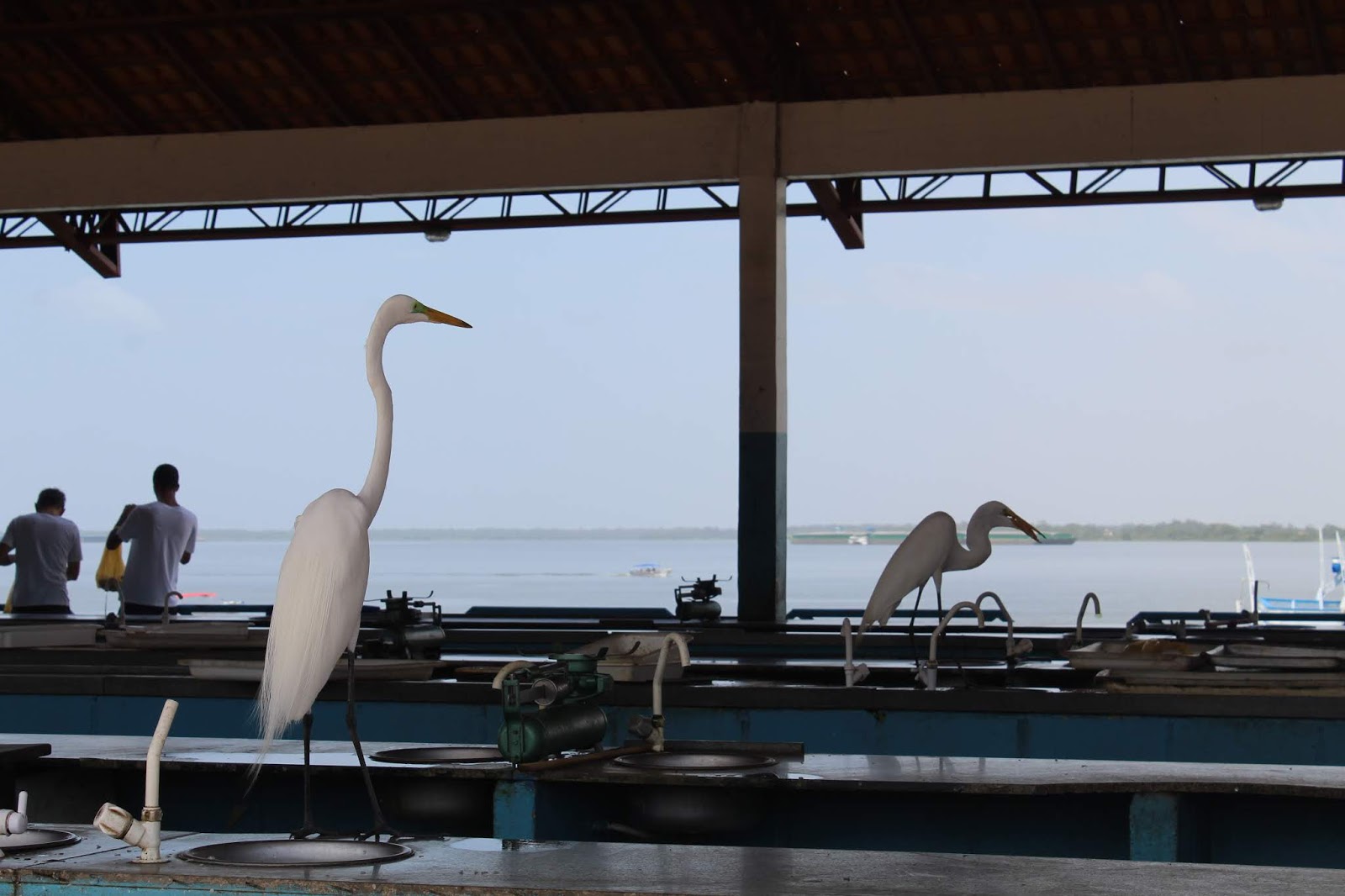
Fish cleaning station on the edge of the Amazon River.


Finding the beauty in our home! 


Can you find what’s wrong with this photo? 

"Freezing" and Gathering Supplies


We heard a word many times this morning that we never expected to hear from more than one person in the Amazon: "freezing."  Strangely enough, though the air is thick and humid (89%!) and the temperature at its lowest is about 75 degrees Fahrenheit, the fans in our rooms get enough of a breeze going that some of us were unprepared for how downright chilly we felt in our hammocks.  By morning, different ones of us had gotten up and acquired hooded sweatshirts, blankets, and even one sleeping bag to cope with the draft.  Over breakfast, several people -- but not all -- actually used the word "freezing" to describe their experience of the night.  Wow.  Plan for tonight: more clothing from the get-go.  We're not turning off the fans, because they help to disrupt the mosquitoes who might otherwise hang around and feed on us.  No matter what, we learned one very important thing: we LOVE our hammocks!

Some of our readers are saying to themselves, "I could NEVER sleep in a hammock for a whole night, let alone for a whole month!"  We understand why you might think that, but we actually did hammock training, practicing how to position our bodies in the hammocks (diagonally) so that you can lie flat instead of in a backbreaking "V." We also worked with our ropes and loops to get things positioned just right for maximum comfort.  We also taught each other some tricks that allowed us to sleep on our sides and to distribute our weight in the best possible way.  We have really picked up some skills quickly in this important element of our lives in Brazil. We're sure our desperation to get real sleep after our 30-ish hour sleep deprived travel odyssey has nothing to do with our quickly developed talents.  

Despite our complete commitment to getting meaningful sleep, we had a few obstacles that were pretty difficult to overcome.  One was the two (relatively cute) dogs that live on the grounds of our guesthouse.  They just stay outside all day and wander around the plants and behind the buildings or just sit out in the front yard. In the night, they decided to start barking.  And barking.  And barking.  When we went to find out what they were barking about, we learned that they were digging holes and egging each other on.  It took a long time for them to tire of this little routine.  One thing that slowed their enthusiasm for their digging job was our second obstacle: a big sudden downpour that included some pretty gusty winds.  It rained HARD, which we think is a part of everyday (almost) life here.  It's no surprise that it rains in the rainforest, so we just need to get used to the weather outside changing in the night.  Despite these challenges, we were pretty successful in catching up on our rest and we are going to make a similar commitment tonight to get ourselves fully on track.  

After our breakfast of eggs, fruit, bread, juice, and coffee, we headed to the central open market in downtown with our local guide (and newfound friend) Lorena.  She is acquainted with our driver 
Maia due to her work with a local tourism agency and she speaks excellent English, so she was a perfect escort for us as we explored downtown Santarém.  

At the market, she showed us the awesome fish that the Amazon produces, some of which were as much as three feet long.  Maybe longer.  She told us about the prehistoric creatures that got trapped in the freshwater zone when the two oceans divided into The Atlantic and Pacific and showed us the unbelievable fish species that resulted from that moment (and that look quite prehistoric, we must admit). We also checked out the meat market but it is a bit gross, to be honest, even for those of us who are hardcore carnivores.  

We hustled through the meat market pretty quickly and then encountered probably our favorite section of the market: the natural remedies area.  Lorena knew a lot about local practices and could pick and choose from among the vast selection of options to show us some of the most useful ones that were there.  A couple of us have slightly scratchy throats so we got a local remedy that we just apply to the outside of our necks to turn things in the other direction.  (We'll have to report in later about the effects.). A few other things sparked our interest, including a salve that seemed a bit solid.  Lorena remarked that because it was "cold today," the salve was not quite as fluid as it usually would be.  It was something like 77 degrees but with the humidity and we were all dripping with sweat.  "Cold" was not a word that was coming into our minds.  

After the market, we ran some important errands to get things together for our time in the community upriver (Anã) that is our primary destination.  We needed laundry soap and a new battery for our water purifier, among lots of other small things. We ran around all over the place and sometimes had to go to several places to get the particular thing we needed.  In a few cases, the thing we got was not the thing we needed.  We’ll try again tomorrow.

At one stop, most of us waited in the van while Shawny and Lorena pursued a tech item. Things went on a little longer than anyone expected and so we cranked up the ‘90s tunes and fired up an impromptu dance party in the van.  We also played a few games that we are going to adapt in Anã next week.  

We came home for lunch and had more fried chicken and a local fish called tambaquí, along with beans and rice, salad and fruit.  From this point forward, we think we can stop saying that we had beans and rice and salad and fruit for lunch (and for dinner) because it is just a given that those things are at all of our meals, except maybe breakfast.  

After lunch we might sometimes take a brief “sesta” or rest, but not today, because we had more errands to run.  Also, our local driver, Maia, had an even more important job to do: pick up our last two teammates: Jesse (our other instructor) and his son Gui.  We all left the guesthouse and headed downtown while Maia made the airport run.  

We crisscrossed through the downtown area going block by block and looking for a famous Braziian product: Havaianas flip flops.  They sell them in shoe stores and even in pharmacies all around the downtown area.  But the styles and sizes and inventory are different everywhere, so it can be quite the treasure hunt to find a great pair for each of us who wanted some.  About half of us were successful and the other half will no doubt keep trying.  

At one point our big group noticed a natural medicine storefront and about half of us diverted into it while the other half went to the bank to get more cash.  We had a plan to reconnect but the plan didn’t work, so we each started back down toward the river with a suspiciously similar goal: to get some of the great ice cream we’ve heard that Brazil is famous for.  After a few messages between the two groups, we all landed at the same ice cream shop and had our fill of Amazonian flavors like acai, cupuaçú, maracujá, coconut, and Brazil nut.  Along with all of these, a lot of us like the one called “floco,” which is basically a variation on chocolate chip that is otherworldly.  

Jesse and Gui finally connected with us around the hammock market, and now we are complete!  Jesse and Gui aren’t quite complete, as their bags strangely did not come with them on their direct flight from Brasilia.  Weird.  We had one other missing bag from the big group’s arrival yesterday that also didn’t appear today, so we are all lending and loaning things to all three of them to carry them over until tomorrow when we think all of our bags will rejoin us as well.  

We came home and had dinner that led into our evening reflection about the human connections we are already making with the people of Brazil.  We told stories to each other about interactions we are having and what we are learning about ourselves and about Brazil based on these interactions.  In particular we noticed how warm and welcoming everyone has been to us, even though none of us (not counting Jesse and Gui) is very good at speaking Portuguese.  Everyone who has tried feels very encouraged by our hosts and even the strangers we are meeting out in the streets.  We noted that visitors to the US with broken English might not be so lucky and we even vowed to be more welcoming hosts in our future back home.  We also decided to work more language tutorials into our everyday lives and assigned the camp/water/reflection chore team to take up this job. 

We are aliens in this place but we are getting some moments of clarity that are very surprising to us, especially because they are occurring so early in our trip.  Even further, we haven’t gotten to our primary destination yet.  We made the error of staying up and having fun together much too long tonight, with the last stragglers staying up until almost 1am.  Oh well.  It was worth it!


While the DIRTies were touring Santarém, they were lucky enough to visit one of the bustling fish markets.


Lorena, the DIRTies' English/ Portuguese tour guide, shows and talks about the fermented fruit murucí. 


The photo captures one of the stands the DIRTies visited and the fruit that was present. 


Malia looks out onto the expanse of the Tapajós River.


We saw dinosaurs today! Just kidding – those red fish laying there are actually just prehistoric. They ended up in the Amazon River during the formation of the Andes Mountains (which came up through the ocean). Thus, these fish were isolated and never evolved past their original state. 


“These are the most dangerous fruits in Brazil. If you’re walking along not paying attention, BOOM, you’re dead” – Lorena, our Santarém tour guide. 


According to Gui, “If one goes down, they all go down” - you can obviously see why! 

Wednesday, January 8, 2020

Hammocks and Fried Chicken


Our travel odyssey went on and on and made it so that we spent more time in Miami than we thought we were going to spend in Manaus when we hired transportation to hotel rooms.  By the time we got to Manaus, we could only spend about two hours at that hotel, so we purposely chose not to sleep and used the time to eat and shower.  Those showers made all the difference and we got our fourth or fifth wind to help us make our way to our first Amazon home.  

We got to Santarém at about 3:00pm local time, which gave us time to wrangle our massive loads of luggage into our big lovely bus (driven by our new friend Rossi, accompanied by his wife Katia and their daughter Sofilha) and hurry down to the outdoor market to pick out our own personal hammocks that we will use for the rest of trip.  In our eight previous trips to the Amazon, the ritual of buying our hammocks has always been a primary rite of passage (and means of keeping very tired travelers awake).  

The hammock market is not actually enormous but the range of options is mildly overwhelming.  That is, each of us kept seeing and touching another hammock and another hammock and finding ourselves unable to decide which one thrilled us the most.  A few people jumped right in, having seen the beautiful hammock of their dreams right before them.  But even they played it cool, so we could see if the prices would come down a bit, especially if we bought more than one hammock from the same vendor.  We saw some dramatic price changes and were happy we had figured out how to play the market game on our first day onsite.  

We had three criteria that Shawny encouraged us to try to meet: 1) get a “double” (large sized) hammock for maximum comfort, 2) get one with a “veranda,” which is the lacy/woven overhang that helps the edges of the hammock not to curl in on themselves, and 3) find one with a strong loop that holds it on its hook (or the rope that is tied to the hook). Most of us met all three marks, but a few of us were in love enough with a different type that we defied one or more of these guidelines. Once we got them home and started “learning” how to tie the knots that would keep them stable, we become more and more enamored of our new sleeping stations.  Some of us rigged our mosquito nets in very creative ways over them and all of us figured out ways to give ourselves some wiggle room as we lined up along the hooks along the wall and staked our claim in our respective room.  

On the subject of “learning” the knots, it really matters how you tie the thing to its anchors if you want to keep your hammock (and your own butt) off the ground. We didn’t exactly absorb all of the particulars because our dear friend (and current cook) Dona Maria jumped up on benches and chairs to tie nearly all of our hammocks up for us.  In our state of exhaustion, we might not have been primed to absorb the whole lesson, but we see that there are important details that we will need to attend to if we are ever to tie one these things properly on our own.  

We knew better than to get too comfortable in our hammocks, because we had resolved to stay awake until after dark to get our bodies attuned to our new timezone (five hours ahead of California).  So we hopped up and got some things organized and started our team chore rotation of video, camp/water, and kitchen duties (including meal prep backup and dishwashing).  The video team set up an editing station in the classroom on our hostel’s small courtyard, the camp team started cleaning and organizing (but not purifying water yet, as we bought enough to get us through at least tomorrow), and the kitchen crew got behind Dona Maria and got instructions for serving and cleaning up dinner.  

Dinner, by the way, was delicious fried chicken (with a promise that even greater and more glorious fried chicken was still ahead), beans, rice, pasta, salad, bananas, and bread.  We also had acerola juice and bottled water, and all seemed right with the world.  

We set up a shower rotation and agreed to meet as a group at 9pm to do a group reflection on our experience so far.  Malia had a book report still dangling from our meeting last Saturday so she led us off reviewing some of the economic, social, and political information that we’ve been covering for the last few months.  Then Team Girassol took up the question of what we are observing about the socioeconomics of Brazil in our first glimpses of it.  

Despite our diminished capacities, we had a full-on discussion of economic justice and the range of models we have seen in our lives and in the last 24 hours plus as we moved from San Francisco to Miami to Manaus to Santarém.  Shawny assured us that everything we touched on would come to new light when we get to our eventual destination in the remote(ish) community of Anã this Friday.  

After this long and exhilarating day, we found our way into our hammocks by about 10:30, so that we could each have at least eight hours of sleep before Dona Maria arrives to begin breakfast around 6:30am.  Hopefully we can sleep through the beginnings of breakfast prep and make up for all of the sleep we missed as we traveled.  

We are happy, healthy, curious, excited and perhaps best of all: together.  We can tell that something very special is about to happen for each of us and we can’t wait to tell you all about it through these pages (and the pictures and videos that will eventually accompany them) and when we see you after our return.  We know that some of you are anxious about what we’ve gotten ourselves into.  We’ll do our best to comfort you when we can, make good decisions when we are out on our own, and maximize the transformative experience that we have promised ourselves.  Thanks for coming along with us; watch this space as its content unfolds . . .


Hour number ten of waiting to actually travel to Brazil in the Miami airport. Mr. Worldwide was not present :( 


Here, we see students boarding the plane for Manaus… for the second time… they’re still in high spirits… little did they know… they’d be kicked off one more time… their spirits, were thus, crushed. 


ABSOLUTE CHAOS IN THE MANAUS AIRPORT (we hard a hard time figuring out the bag situation). 


At least American Airlines was nice enough to feed us  (with dry sandwiches)!!! 


Beautiful picture of our new home for the next month! 


It was super fun to pick out our new beds. Thankfully, we didn’t have to test out the mattresses, but we still can’t rip off the tags. 


Jaron and Sofilha sharing a super sweet moment while walking the streets of Santarém. 


Monday, January 6, 2020

Travel update

We've been in motion since 4am California time and even though we are supposed to have touched down in Manaus by about now, we are strangely still sitting around on the floor of the Miami airport. We switched gates three times, switched crews three times (so far) and now hope to get there in time for our flight to Santarém tomorrow afternoon. Our chance to sleep in hotel rooms for a few glorious hours has probably slipped away.

But, as with all things DIRT, there are a number of silver linings to be seen. First, we are all together, we are happy, and we are feeling fine. We busted out Uno cards and started playing rounds to seventh, eighth, and ninth place because we had loads of time. Also, nothing has really gone wrong. That is, we all had tickets, no one lost a bag or passport, and no one is in a terrible state. As a side note, we almost caught a view of the Space X launch out of Cape Canaveral, but we just missed it. We all got more time than usual to say goodbye to folks by phone from Miami. And this is a weird one, but there are much better food options in this airport than we’ve experienced here on past trips.

The airline fed us horrible sandwiches and potato chips but it’s enough to tide us over until we can sleep on the plane. We had plans to watch movies and sleep only a bit on this flight to help us reset our internal clocks but we’ll have to rethink that plan now. We hope to still hit the hotel for a meal and a shower but if that doesn’t happen, we’ll be fine.

So far we are doing a great job of keeping track of our stuff, being on time, taking care of each other, and maintaining good spirits. We even decided that this little hitch in our plan is good for us because everything has been going so perfectly. We have every intention to “embrace the chaos” so this is good practice for all that is before us.

Don’t worry. We’re fine. And we’ll stay that way!

Monday, December 30, 2019

Amazon DIRT 2020!!

Our teams have come together to introduce themselves as we prepare to leave for the Brazilian Amazon this January.  Watch this space to see what we are learning and doing as we seek to immerse ourselves in the beautiful community of Anã in the state of Pará.

Here are our three teams:

Lulas


Girassol


Comemos